


At Charlottenlund we offer balloon dilation of the Eustachian tube.
Many people experience ear pain during flights, where the pressure changes in the cabin (especially during landing) cause ear pain. Most adults can equalize the pressure by simply swallowing a little water, or yawning, while others have to hold their nose and breathe with their mouth closed - a so-called "Valsalva maneuver". Others cannot equalize the pressure at all and have to just bite down on the pain or wait for the eardrum to burst. In these patients, the pain can persist for several days after the flight and lead to fluid accumulation in the middle ear and hearing loss in the following weeks. Often, these patients have been so-called "ear children" in their childhood.
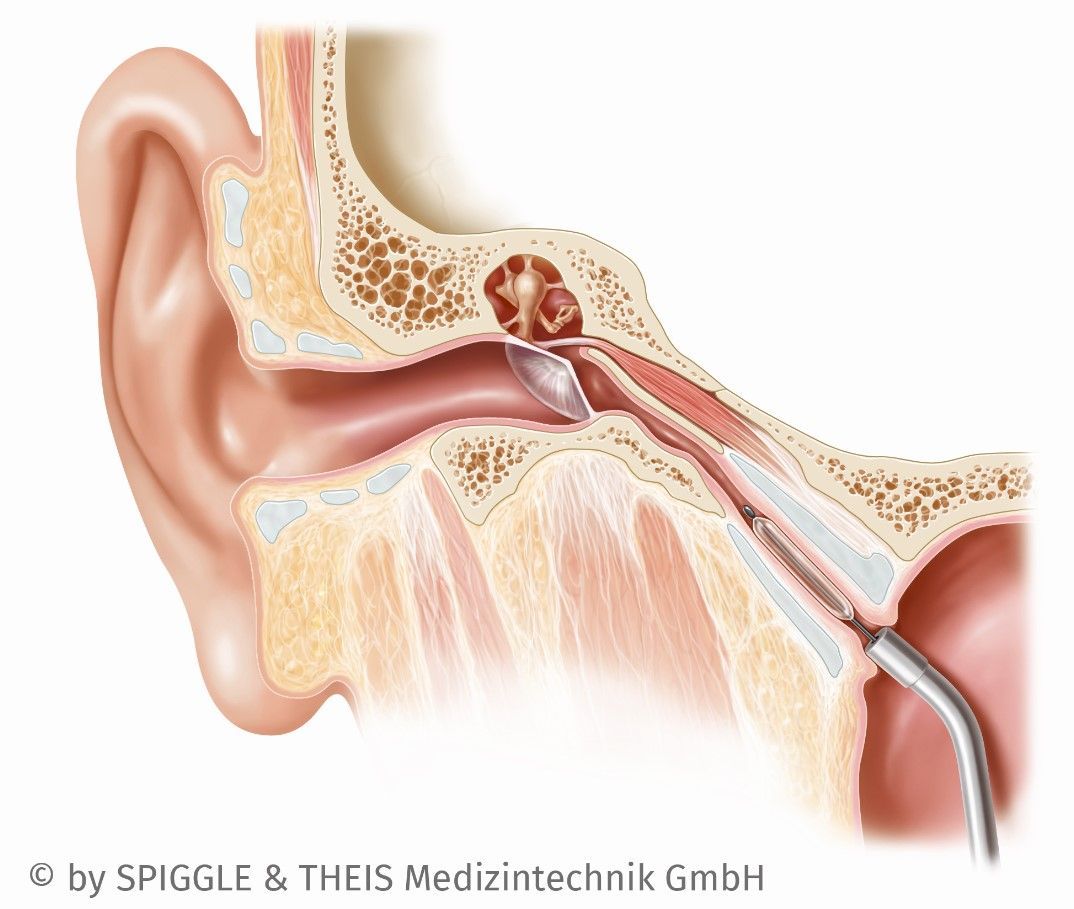
In many cases, the problem can be remedied by balloon dilation of the Eustachian tube. This is done with a small balloon that is inserted through the nose and inflated to a very high pressure. If you want to read more about this, you can read the story of Felicia, who was treated by specialist Jacob Fisker at Charlottenlund Private Hospital and subsequently wrote the following:
"Earlier this year, I had surgery with you after narrow eustachian tubes had prevented me from boarding a plane for 7 years due to severe discomfort and problems with pressure equalization. Today I had my ears tested on a flight. The surgery made a much bigger difference than I dared to hope for and now I don't have to feel discomfort in my body when I think about traveling around the world. So a heartfelt thank you to you🌺 it will have a great positive impact on my life."
Read Felicia's story in the magazine "Sportsdykeren" here!
At Charlottenlund Private Hospital, specialist and owner Jacob Fisker performs all balloon dilations of the Eustachian tube and has many years of experience with this type of treatment. Jacob Fisker is an active diver himself and has also completed the Danish Armed Forces' training in diving and aviation medicine and has over the years treated countless patients who often travel by plane, divers, pilots and stewardesses - and has thereby gained a great deal of experience and knowledge in the field.
You are always welcome to contact us if you have any questions or would like to book an appointment for a preliminary study.
What is the Eustachian tube?
The Eustachian tube connects the ear and the pharynx, and its primary function is to equalize pressure in the ear. The Eustachian tube is normally closed, but it opens briefly when you speak, swallow, or yawn. When the tube opens, air is simultaneously transported from the pharynx to the middle ear. In addition to equalizing pressure in the ear, the Eustachian tube also allows mucus to move from the middle ear to the pharynx.
If there is no free passage for air to move through the Eustachian tube, you will experience it as a plugged sensation in the ear, and over time fluid and hearing loss may develop in the ear. Many people mistakenly believe that this is an ear canal that is blocked by earwax, as the sensation is the same. If you cannot equalize pressure, it may be a sign that the Eustachian tube is not working as intended.
Impaired function of the eustachian tube
The Eustachian tube is more important to our well-being than you might think. A blocked Eustachian tube is immediately felt as a pressure or a plug in the ear, causing hearing loss that makes it difficult to hear what other people are saying, while also distorting your own voice. However, an open Eustachian tube (so-called tuba aperta) can also give the sensation of having a plug or a ringing in the ear, while your own breathing and voice echo in your head. This can make it difficult to concentrate and be terribly annoying.
Some people are born with a dysfunctional Eustachian tube, but the problem can also arise later in life for many different reasons – for example allergies. The condition means that the tube is constantly blocked, or that the problem returns repeatedly. The condition creates negative pressure in the ear, and if blocked for a long time, fluid builds up in the middle ear, which can, for example, cause chronic otitis media.
How do we make the diagnosis?
During a preliminary examination by the specialist, a thorough review of the medical history from childhood to adulthood is carried out. Have there always been problems with the ears, or is the problem new? This - and much more - gives the specialist important information about the options for treatment. A thorough hearing test is carried out as well as a so-called tympanometry, where the middle ear pressure is measured with an advanced measuring device and the mobility of the eardrum is assessed. A video recording of the mobility of the eardrum is also made while the patient is sitting up, where it is determined whether the patient can equalize the pressure or not.
If you experience symptoms of a blocked Eustachian tube, we at Charlottenlund Privathospital recommend that you have this examined to see if anything can be done to improve the condition. Our leading ENT doctors can quickly and accurately help identify during the initial examination whether the Eustachian tube is dysfunctional, or whether it is open, and whether balloon dilation is necessary. The doctor examines the ears thoroughly and then assesses what treatment is needed to remedy the problem.
However, it could also be another condition, such as chronic otitis media. See what different ear treatments and surgeries we offer at Charlottenlund Private Hospital.
Treatment of impaired function of the eustachian tube
If the specialist, based on the examination, assesses that the symptoms can be alleviated by balloon dilation of the Eustachian tube, you will be referred for surgery. The surgery is called "tubal dilation" in medical terms and this is an effective treatment that, in most patients, provides a long-term improvement in the function of the Eustachian tube. This procedure will in some cases be covered by your health insurance, but is unfortunately no longer covered by the extended free hospital choice for citizens in Region H. For citizens in all other regions, it is still possible to be treated at Charlottenlund Private Hospital - completely free of charge - through the extended free hospital choice. If you do not live in the Capital Region and are referred to a public hospital where there is a waiting time, you will in many cases be able to have surgery with us. Talk to your patient advisor at your home hospital about the options.
How is balloon dilation of the Eustachian tube performed?
The operation lasts approx. 30 minutes and is performed under full anesthesia. It is performed through the nostrils using a scope and probe. A balloon is inserted up through the nasopharynx and into the Eustachian tube, which is inflated and held still for 2 minutes. Approximately 75% of all patients experience an effect after the operation. This means that after the operation, you will most likely be able to equalize the pressure in the ear again, and that air can pass freely from the middle ear to the pharynx. This will make it possible to travel by plane without experiencing ear pain, and perhaps take the diving certificate that you have always dreamed of, but never got around to taking because of ear pain.
Patient opinion:
''I had a balloon dilation and it saved my career as a diver! Super professional and safe place. THANK YOU.''
- Maria Bollerup
Book an appointment for balloon dilation of the Eustachian tube
At Charlottenlund Private Hospital, we have many years of experience in treating patients with impaired Eustachian tube function, and our experienced ENT doctors are ready to help you.
Contact us today for more information about balloon dilation of the Eustachian tube or to schedule a consultation.
Read also about:
Drainage in the eardrum
Straight ears
Chronic otitis media
Frequently Asked Questions
Earplugs?
Many people experience a sensation of plugging in the ears or ringing in the ears. This can be due to the Eustachian tube either being completely open - this is called "tuba aperta" - or it can be due to negative pressure in the middle ear.
At Charlottenlund Private Hospital, the specialist will perform a thorough examination and measure the pressure in the middle ear. This will determine whether your discomfort is due to an open or closed Eustachian tube.
If the problem with "plugs" in the ears is due to negative pressure in the middle ear that does not equalize itself when you swallow, balloon dilation of the Eustachian tube is an option.
Do you experience pain when flying?
Many people experience ear pain during flights, with pain being particularly pronounced during landing, while it typically does not hurt when the plane takes off.
This is due to pressure changes in the middle ear, which easily equalizes itself when the plane takes off and the cabin pressure drops, while the pressure cannot equalize itself when the plane begins to descend and the cabin pressure rises again.
The pain can be severe and last for several days, and can be accompanied by fluid buildup in the middle ear and bleeding in the eardrum, and in the worst case, the eardrum can rupture.
Balloon dilation of the Eustachian tube is an effective treatment - read Felicia's story here on this page.
Would you like to get a diving certificate?
Have you always wanted to experience a world below the sea surface, but were well aware that it could not be done due to problems with pressure equalization?
At Charlottenlund Private Hospital, specialist Jacob Fisker has treated many recreational and professional divers, who have thus been given the opportunity to start or continue diving.
How long will it take before I can equalize the pressure?
After a treatment, swelling will naturally occur in the treated area, that is, inside the eustachian tube. Therefore, you will typically not be able to equalize pressure for the first 14 days. After that, you will gradually start to be able to squeeze air through - and from there it should only get better.
Your own participation in the aftercare in the form of continuous and repeated pressure equalization many times a day is incredibly important for the result.
Can't the procedure be done under local anesthesia?
We can easily perform the procedure under local anesthesia instead of general anesthesia, but we almost always choose the latter, as many people will experience discomfort during the procedure despite local anesthesia. To ensure the best procedure and the best experience for you, the treatment is therefore most often performed under a short general anesthesia from which you wake up after a few minutes.
Can I be treated through the public sector?
It is not possible for citizens in the Capital Region of Denmark to have the treatment carried out through the so-called treatment guarantee.
Citizens from other regions can be treated free of charge through the so-called "extended free hospital choice" also known as DUF. If you live outside the Capital Region, you can ask your patient advisor at the local hospital you are referred to to be referred to Charlottenlund Private Hospital free of charge.

Before the operation
Before the operation, you should have used a prescription nasal spray containing adrenal corticosteroid for 2 weeks. We also recommend that you purchase over-the-counter medication such as Panodil before the operation, as some patients have mild pain after the operation.
After the operation
Some patients experience mild ear pain or pressure after the operation, which is usually just a good sign that the procedure has had the desired effect. After the operation, you will be treated preventively with antibiotics for one week in the form of broad-spectrum penicillin tablets and two different nasal sprays for one week (Zymelin/Otrivin) and two months (adrenal corticosteroid nasal spray). The day after the operation, you will start equalizing the pressure many times an hour, which should continue until the check-up two months after the operation, so that you can train the function of the Eustachian tube.
Approximately two months after the operation, you will be called in for an outpatient check-up, where your ears will be examined and we will assess the effect of the procedure. At this time, we will also decide whether further check-ups are needed – but this is often not necessary.
Complications
The risks of the operation are very small. After the procedure, soreness in the ears and nose and some bleeding from the nose may occur. An effect in the form of healing can be expected in approximately 75% of the treated patients. There is a small risk of otitis media.


Book an appointment for treatment
If you would like to be treated with us, please feel free to contact us. Our secretaries are ready to help and answer any questions you may have, as well as to find time for both the preliminary examination and the surgery.