


Plantar Warts and Warts on the Fingers – Treatment by a Dermatologist
A specialist in dermatology examines and treats warts on the feet, hands and fingers in both children and adults.
Warts (verrucae) are benign skin growths caused by infection with human papillomavirus (HPV). Plantar warts occur on the soles of the feet and grow inwards into the skin, while warts on the hands and fingers are typically raised and rough. At Charlottenlund Privathospital, warts are examined and treated by Susanne Birkballe, specialist in dermatology, in children of all ages and adults. Treatment may include freezing, curettage or prescription treatments, depending on the type and location of the wart and the patient’s age.
What are warts?
Warts are small, benign growths that develop when human papillomavirus enters through tiny breaks in the skin and causes skin cells to grow more rapidly. They are harmless, but they are contagious and can spread through direct skin-to-skin contact or indirectly via damp floors in changing rooms and swimming pools.
Plantar warts occur on the soles of the feet and are pushed inwards into the skin by body weight. They are therefore often flat, may be surrounded by thickened skin and can be painful when walking. Warts on the hands and fingers, by contrast, are usually raised, rough and cauliflower-like and often occur around the nails. In the Dutch study, 20% of the children had plantar warts, while fewer had warts on their hands.
Many warts disappear on their own as the immune system gradually learns to recognise the virus. In a follow-up study of schoolchildren, around half of the children with warts were wart-free within one year.
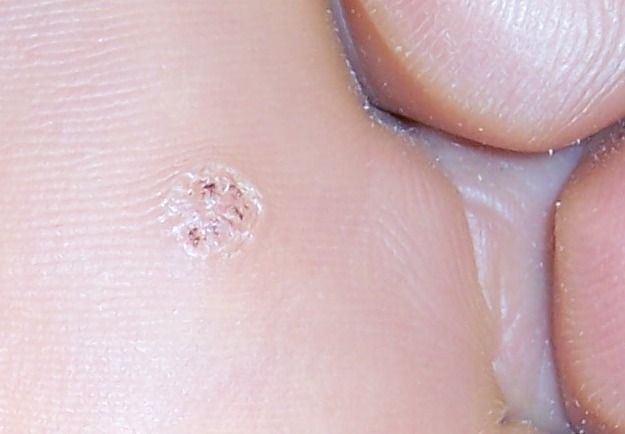
A plantar wart with characteristic black dots – tiny clotted blood vessels. The skin lines run around the wart.
Photo: Simon Nuttall, CC BY-SA 3.0
How can you tell the difference between a plantar wart and a corn?
A plantar wart and a corn can look similar because both occur on the sole of the foot and may be surrounded by thickened skin. A plantar wart often has small black dots in the centre – these are tiny clotted blood vessels – and the natural lines of the skin run around the wart rather than through it. A corn develops where footwear causes pressure and has a hard, glassy core without black dots.
If you are unsure, a dermatologist can distinguish between the two during an examination so that the correct treatment can be used.
When should you see a dermatologist about warts?
You should see a dermatologist if the wart is painful, growing or spreading, or if pharmacy treatments have not worked after a few months. This also applies to warts under or around the nails, warts on the face, and having many warts at once.
If you have diabetes, a weakened immune system or poor circulation in your feet, warts on your feet should be assessed by a doctor rather than treated at home. Warts around the genitals require a different assessment, and the dermatologist can also test for sexually transmitted infections.
A new bump in an adult that is thought to be a wart but is growing, bleeding or changing colour should always be examined, as other skin lesions can look like a wart.
How does a dermatologist treat warts?
Treatment is selected based on the wart’s type, location and size and the patient’s age. The most common treatment is freezing, in which the wart is treated with a very cold substance. A small blister may form afterwards, which dries out before the wart falls away.
The wart is often prepared by removing the thickened, hard skin so that the treatment can penetrate more deeply. If necessary, the wart may also be removed by curettage, or prescription treatments may be prescribed for use at home.
Warts can be persistent, and several treatments at intervals of a few weeks are often required. No treatment works every time, and a wart can return because the virus may remain in the skin. The specialist develops a treatment plan and assesses at follow-up whether treatment should be continued or changed.
Plantar warts in children
Warts are very common in children, particularly at school age, and many disappear on their own. Treatment therefore makes most sense when the wart is painful, interferes with sport or play, or does not go away.
The dermatologist also treats very young children and selects a method suited to the child’s age and ability to tolerate the treatment. Freezing can be uncomfortable, so other methods may be considered for very young children.
Can you remove plantar warts yourself?
Many warts can be treated at home with acid-based treatments or freezing kits from the pharmacy, and these tend to work best when the hard skin is filed down first. In a combined analysis of multiple studies (a Cochrane review), acid-based topical treatment showed a clear but moderate benefit compared with no treatment.
You should not cut into a wart yourself, and home treatment should not be used on the face, genital area, or if you have diabetes or poor circulation. If the wart has not changed after several months of treatment, it should be assessed by a doctor.
How can you avoid spreading warts?
The risk of transmission can be reduced by wearing pool shoes in changing rooms and swimming pools, not sharing towels or socks, and covering the wart with a plaster. Avoid picking at or biting warts, as the virus can spread to other areas of skin – for example, from one finger to another or from the foot to the hands.
Referral and payment
Many private health insurance policies cover examination by a dermatologist, but insurers typically require a referral from the patient’s GP and prior approval. Self-paying patients do not need a referral. Prices are available in the price list. Consultations take place at the main hospital in Charlottenlund.
Frequently asked questions
How do you know if you have a plantar wart?
A plantar wart is located on the sole of the foot, is often surrounded by hard skin and has small black dots in the middle. It typically hurts when you walk. If you are unsure, a dermatologist can determine whether it is a wart or a corn.
What happens if you don’t remove a plantar wart?
Many warts go away on their own, especially in children. However, a wart can also grow, become painful and spread to others, in which case treatment may help.
How does a dermatologist remove a wart?
The dermatologist can freeze the wart, scrape it off or prescribe medication. Several treatments spaced a few weeks apart are often needed.
Does it hurt to have a wart frozen?
Freezing may sting and hurt briefly, and a small blister may form afterwards. For this reason, other methods may also be considered for young children.
Can young children have warts treated?
Yes. The dermatologist treats children of all ages and chooses a method suited to the child’s age.
Do you need a referral to see a dermatologist about warts?
If you are paying privately, you do not need a referral. If you are using health insurance, the insurer will typically require a referral from your GP and prior authorisation.