


Allergy Treatment – Allergy Testing and Allergy Immunotherapy (SLIT)
Assessment of allergies affecting the nose, eyes and skin – and allergy immunotherapy for grass pollen, birch pollen and house dust mites.
At Charlottenlund Privathospital, allergies are assessed with allergy testing, and patients with significant hay fever or house dust mite allergy may be offered allergy immunotherapy as tablet treatment (sublingual immunotherapy, SLIT). The assessment is carried out by specialists in ear, nose and throat medicine, dermatology and paediatrics and is based on a discussion of symptoms together with a skin prick test, a blood test (specific IgE), or – if contact allergy is suspected – a patch test. Both children and adults can be examined. Allergies affecting the nose and eyes are assessed at all of the hospital’s ENT departments, while skin allergy, allergy in children and initiation of allergy immunotherapy take place in Charlottenlund.
What is an allergy?
An allergy is a reaction by the immune system to substances that most people tolerate without problems – for example pollen, house dust mites, animals or certain foods. In respiratory allergies, the body produces allergy antibodies (IgE), and contact with the substance can cause sneezing, a runny or blocked nose, and itchy, watery eyes. Contact allergy of the skin is a different type of allergy in which the reaction develops more slowly and appears as eczema.
Source: Mosbech H, Madsen H. Rationel Farmakoterapi no. 5, Danish Health Authority 2023
Many people with hay fever go untreated. In a Danish population study, just over four in ten adults with allergic rhinitis had not received treatment in the previous year (Larsen et al., Clinical Respiratory Journal 2013).
Which allergies are assessed at Charlottenlund Privathospital?
Allergies can affect the nose and eyes, the skin or—in children—also present as reactions to food. Allergy assessments are therefore carried out by three specialties, depending on where the symptoms occur.
When should you have an allergy test?
An allergy test may be relevant when symptoms return at the same time of year or in specific situations, and when ordinary over-the-counter medication is not sufficient. Testing is also necessary if allergy immunotherapy is being considered, as treatment is only started once the allergy has been confirmed.
Typical reasons for having an allergy test include:
- sneezing and a runny or blocked nose during the pollen season or throughout the year
- itchy, watery eyes
- coughing or wheezing associated with pollen, animals or dust
- eczema that does not improve with standard treatment
In the event of sudden swelling of the face or throat or difficulty breathing, call 112.


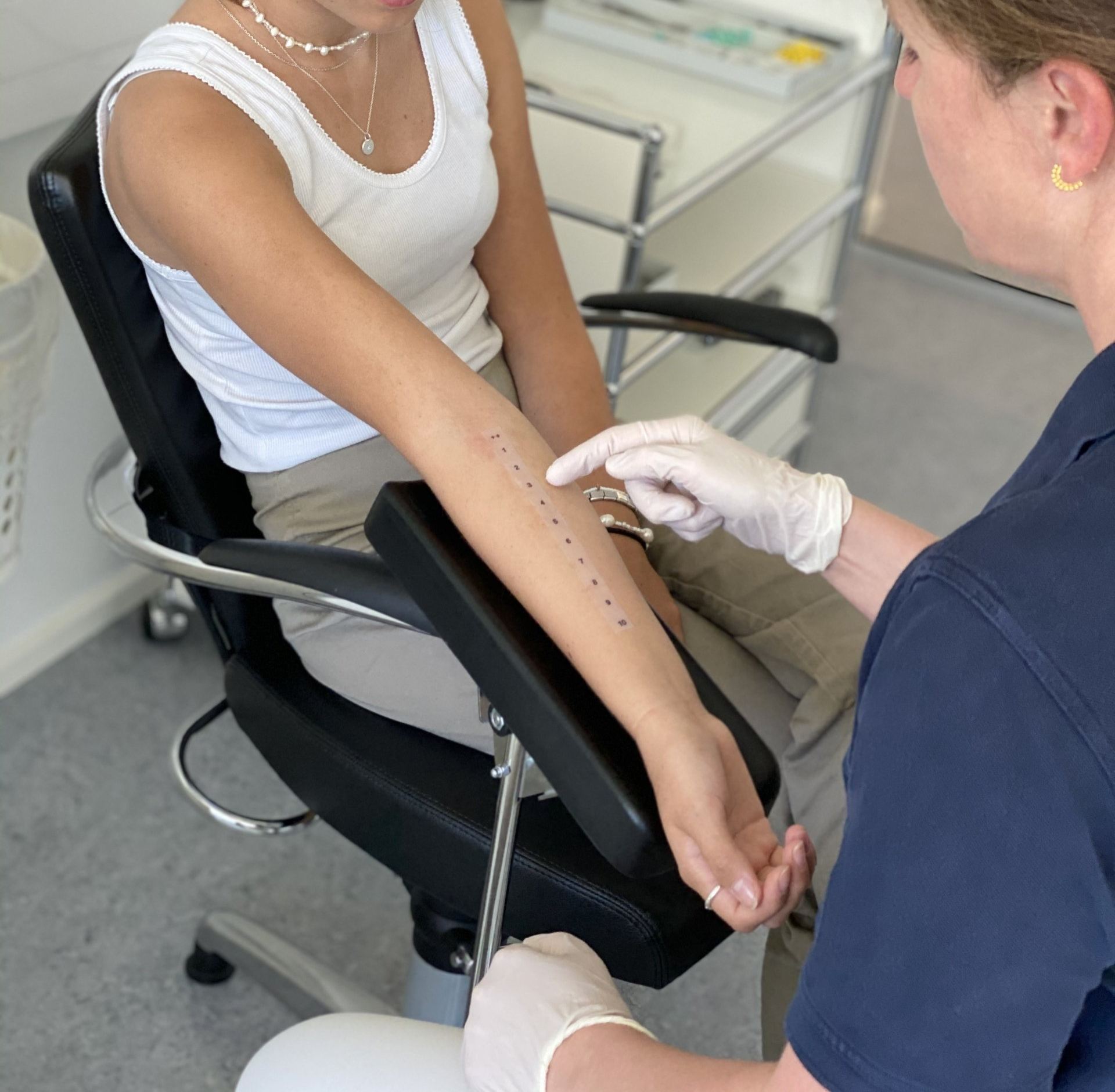
Where can you have an allergy test?
An allergy test can be carried out at Charlottenlund Privathospital without a referral if you are paying privately. Allergies affecting the nose and eyes are assessed by ENT specialists at all of the hospital’s ENT departments at several locations across Denmark. Skin allergies and allergies in children are assessed in Charlottenlund, north of Copenhagen. Both skin prick tests and blood tests are carried out at the hospital, while patch testing is performed by a dermatologist.
What is allergy immunotherapy (SLIT)?
Allergy immunotherapy is a treatment that gradually makes the immune system less sensitive to the substance you are allergic to. With sublingual immunotherapy (SLIT), the allergen is administered as a dissolvable tablet placed under the tongue – without injections. At Charlottenlund Privathospital, tablet treatment is offered for birch pollen, grass pollen and house dust mite allergy. The aim is to reduce symptoms and the need for medication. European guidelines recommend at least three years of treatment to achieve a lasting effect.
How is allergy immunotherapy carried out?
Allergy immunotherapy may be considered when the allergy has been confirmed and symptoms remain pronounced despite standard medication. According to the Danish Health Authority’s Rationel Farmakoterapi guidance, a corticosteroid nasal spray and allergy tablets (antihistamines) should have been tried for at least one season first.
Once the specialist and the patient agree on treatment, a prescription is issued and the allergy medication is purchased at a pharmacy. Usually, only a small amount is prescribed initially to check whether the tablets are well tolerated. The first tablet is always taken at Charlottenlund Privathospital because, in rare cases, significant swelling of the mouth and throat can occur after the first tablet. Treatment then continues at home: the tablet is taken every day, and a nurse closely follows the course of treatment.
Treatment is not started during the pollen season or during pregnancy. The most common side effects are itching, irritation or mild swelling in the mouth, which usually subside. The effect is assessed after the first year or the first season, and treatment is discontinued if side effects are unacceptable or there is no effect. Allergy immunotherapy is initiated only in Charlottenlund.

How are allergies assessed in children?
Children with allergies are seen by the hospital’s paediatricians in Charlottenlund. In children, hay fever, asthma and eczema are often connected, and food allergy is assessed only in children. The examination is adapted to the child’s age, and the paediatrician decides whether a skin prick test, blood test or both are needed. More information about the two most common related topics can be found on the pages about food allergy in children and asthma in children.
Referral and payment
Many health insurance plans cover allergy assessment by a specialist, but insurers typically require a referral from the patient’s GP and prior approval. No referral is required for self-paying patients. Prices are listed in the hospital’s price list.
Medication for allergy immunotherapy is not included in Charlottenlund Privathospital’s prices. It is purchased at a pharmacy and costs approximately DKK 10,000–12,000 per year per allergen (pharmacy price, October 2026). The current price can be found at medicinpriser.dk.
Who will you meet?
In Denmark, an allergy specialist is usually a specialist in dermatology, paediatrics or ear, nose and throat medicine. These are the three specialties that primarily treat allergies. At Charlottenlund Privathospital, all three specialties are available.
Allergy assessment is carried out by specialists in ear, nose and throat medicine, dermatology and paediatrics – depending on whether the symptoms affect the nose and eyes or the skin, or whether the patient is a child. Allergy immunotherapy is followed by a nurse who remains in contact with the patient throughout the treatment course. The hospital’s specialists can be viewed on the staff page.
Frequently asked questions
What are the symptoms of allergies to birch, grass and house dust mites?
Symptoms typically include sneezing, a runny or blocked nose, itchy and watery eyes, coughing and, in some cases, asthma. Birch and grass pollen symptoms are seasonal, while dust mite allergy often causes symptoms all year round.
How are these allergies diagnosed?
The diagnosis is based on your medical history and an allergy test—a skin prick test and/or a blood test measuring specific IgE antibodies. The skin prick test is read after 15–20 minutes. If skin contact allergy is suspected, a patch test is used instead.
What is SLIT treatment, and how does it work?
SLIT (Sublingual Immunotherapy) is a form of allergy immunotherapy in which you take a small dose of the allergen under your tongue every day. The treatment “trains” the immune system to tolerate the substance better and can reduce symptoms and the need for medication over time.
How long does SLIT treatment take, and who can have it?
SLIT is usually given for three years and started outside the pollen season. It can be given to children and adults with a confirmed allergy and significant symptoms that are not adequately controlled with standard medication. Treatment is only started in Charlottenlund.
Are there any side effects of SLIT, and is the treatment safe?
Most side effects are mild and occur in the mouth, such as itching or irritation, and usually pass. In rare cases, the first tablet can cause severe swelling in the mouth and throat, so the first tablet is always taken at the hospital.
Can children have an allergy test?
Yes. Children are seen by the hospital’s paediatricians in Charlottenlund, who decide whether to perform a skin prick test, a blood test or both. Food allergies are only assessed in children.
How do you find out what you’re allergic to?
It involves a discussion about your symptoms and an allergy test—typically a skin prick test and/or a blood test. A skin prick test can detect allergies to pollen, dust mites, dogs and cats, among other things. The specialist compares the results with your symptoms before making a plan.
Can you test yourself for allergies?
There are allergy tests available to buy without seeing a doctor. They usually only show whether the body has produced antibodies, and a positive result does not necessarily mean that the substance causes symptoms. A doctor should therefore assess the result alongside your symptoms.
Is the medication for allergy immunotherapy included in the price?
No. The medication is purchased at a pharmacy and is not included in Charlottenlund Privathospital’s prices. It costs approximately DKK 10,000–12,000 per year per allergen (pharmacy price, October 2026).
Read more about
Allergies are often associated with other symptoms affecting the nose, skin and airways. These are the most closely related pages.
→ Contact allergy and patch testing – eczema caused by substances encountered in everyday life → Food allergy in children –symptoms, testing and treatment → Asthma in children – when allergies and the airways are connected → Blocked nose –causes other than allergy