


Ringworm and fungal skin infections – examination and treatment by a dermatologist
A dermatology specialist determines whether your rash is caused by a fungal infection and provides treatment to prevent it from returning.
Ringworm (tinea) is a fungal infection of the skin – not a worm. It causes red, ring-shaped patches with a scaly border and is most commonly transmitted by pets or other people. Fungal skin infections can also occur between the toes (athlete's foot), in the groin and on the scalp. Ringworm is usually treated with antifungal cream, but it often resembles eczema or psoriasis. In these cases, a skin scraping can help establish the correct diagnosis. At Charlottenlund Private Hospital, fungal skin infections in children and adults are diagnosed and treated by Susanne Birkballe, a specialist in dermatology.
What is ringworm?
Ringworm is a fungal infection in the outermost layer of the skin. Its name comes from the ring-shaped rash—it has nothing to do with worms. The fungus feeds on keratin in the skin and is most often spread by animals such as cats, dogs, guinea pigs and cows, and less often by other people. Ringworm can affect people of all ages, but is most common in children. Athlete’s foot is even more common: 10–15% of adults have athlete’s foot.
Where does fungus affect the skin?
Fungus thrives where the skin is warm and moist, and its name depends on where it appears. Athlete’s foot can spread to the nails and cause fungal nail infection, while jock itch causes itching around the genitals and anus.
How is ringworm spread?
Ringworm is spread through direct contact, and the rash typically appears where the skin has touched the animal or person. Pets can be infected without having any patches in their fur, in which case the animal may need to be examined by a veterinarian. The risk of infection drops quickly once treatment has started.
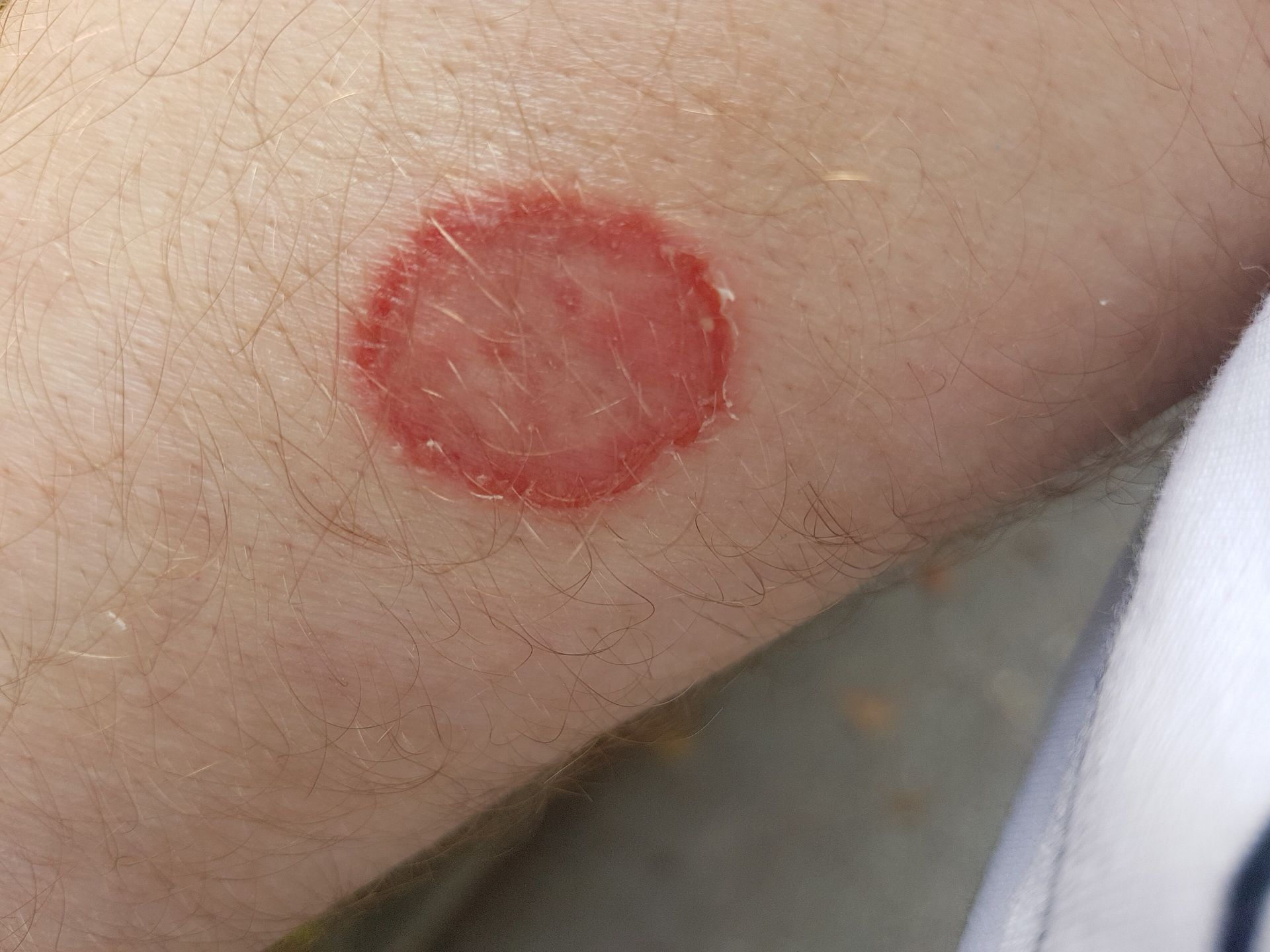
Foto: Asurnipal, Wikimedia Commons, CC BY-SA 4.0

Is it ringworm or eczema?
Ringworm is often mistaken for eczema, psoriasis and other causes of itchy rashes. Ringworm typically has a sharply defined, red, scaly edge that slowly spreads outwards, while the skin in the middle becomes more normal. Treating a fungal infection with a steroid cream can change the appearance of the rash and make it harder to recognise—and conversely, antifungal cream does not work on eczema.
When should you see a dermatologist for a fungal skin infection?
You should see a dermatologist if the rash does not clear up after 2–4 weeks of treatment with antifungal cream from a pharmacy, if it spreads, or if it keeps coming back. This also applies to fungal infections on the scalp or face, if you have a weakened immune system, or if you are unsure what the rash is.
How does a dermatologist examine a fungal skin infection?
The dermatologist examines the rash and often also checks the feet, nails and scalp, as the fungus can affect several areas. If there is any doubt, a small sample is scraped from the active edge and sent for laboratory testing for fungus. If you have used antifungal cream, the test can be falsely negative for up to two weeks, so it is best to stop using it before the examination. At Charlottenlund Privathospital, the examination is carried out by Susanne Birkballe, dermatologist.
How is ringworm treated?
Most cases of ringworm clear up within 1–4 weeks with antifungal cream. It is important to apply the cream beyond the edge of the rash and continue treatment for the full course, even if the skin looks better. Widespread fungal infections, or cases where cream does not work, require tablets. Fungal infections of the scalp in children are treated in hospital.
What can you do yourself?
Fungi thrive in warm, damp environments. Keeping the skin dry, using your own towels and treating the whole family—and possibly your pet—helps prevent the fungus from coming back.

Ringworm in children
Children get ringworm more often than adults, often from pets or other children. Once treatment has started, the child can return to daycare and school the next day. Fungal infections of the scalp are most common in children and cause scaly, itchy patches where the hair breaks off. They require treatment with tablets, which is given in hospital. The dermatologist assesses the rash, takes samples and refers the child for treatment.
Referrals and fees
Many health insurance policies cover a dermatologist’s assessment, but insurers typically require a referral from your GP and prior authorisation. No referral is needed if you are paying privately. Fees are listed on the price list. Appointments take place at the main clinic in Charlottenlund.
Frequently asked questions
Is Ringworm Caused by a Worm?
No. Ringworm is a fungal infection of the skin. The name comes from the ring-shaped rash.
Is ringworm contagious?
Yes. Ringworm is spread through direct contact with animals or people, and via towels, clothing and brushes. The risk of infection drops quickly once treatment has started.
Can You Catch Ringworm from Your Cat or Guinea Pig?
Yes. Cats, dogs, guinea pigs and other animals are a common source of infection. The animal may be infected without having any visible patches and should then be examined by a veterinarian
How long does it take to get rid of ringworm?
Most cases clear up within 1–4 weeks with antifungal cream. Widespread fungal infections require treatment with tablets and take longer to clear up. Fungal infections of the scalp in children are treated in hospital.
Can children with ringworm attend daycare?
Yes. Once treatment has started, the child can return to daycare and school the next day.
What is the difference between ringworm and eczema?
Ringworm typically has a sharply defined, red, scaly edge that spreads outwards, while the middle becomes more normal. Eczema is usually less clearly defined. If in doubt, a skin scraping can show whether it is fungal.