


Surgery for frequent nosebleeds
With nosebleed surgery, sudden and severe nosebleeds quickly come to an end.
At Charlottenlund Privathospital, some of Denmark's most experienced ENT (Ear, Nose, and Throat) specialists are ready to help you find lasting relief from chronic nosebleeds with no waiting times. We have extensive expertise in this field, having successfully performed this procedure many hundreds of times. This deep experience ensures that our clinical standards, patient safety, and results are of the absolute highest quality. The treatment is also frequently covered by private health insurance.
Do You Need Medical Treatment for Nosebleeds?
Almost everyone experiences a nosebleed (epistaxis) at some point, and they are usually entirely harmless. However, when nosebleeds become frequent, heavy, or difficult to stop on your own, they can become deeply disruptive and stressful.
If recurrent nosebleeds are impacting your daily life, a simple, highly effective specialist treatment can resolve the issue.
How Cauterization for Nosebleeds is Performed
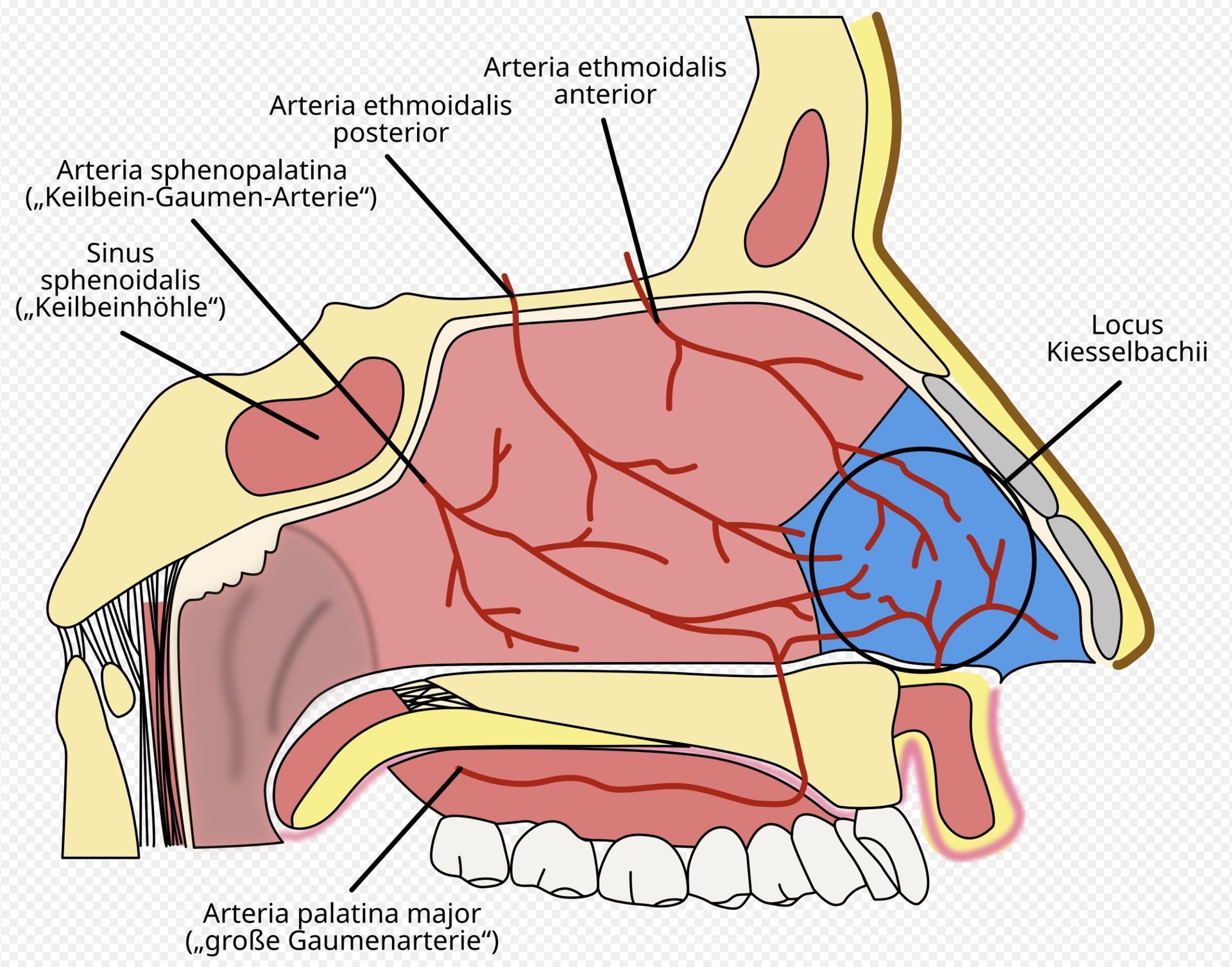
The vast majority of nosebleeds originate at the front of the nasal septum. This highly vascular region, where several small blood vessels converge, is known as Kiesselbach’s plexus (or Little's Area).
During the procedure, the specialist uses precise cauterization (either chemical or gentle heat/electrocautery) to safely seal the fragile, overactive blood vessels causing the bleeding. At Charlottenlund Privathospital, the procedure is performed using advanced endoscopic visualization to ensure absolute precision. To maximize patient comfort, it is carried out under local or general anesthesia and typically takes just 15 to 30 minutes.
Aftercare and Healing — What to Expect
Following the procedure, you will rest comfortably in our recovery lounge for a short observation period before going home the same day.
Most patients experience only mild, temporary discomfort or a feeling of stuffiness in the first few days. Because the nasal lining is highly vascular, minor spotting or oozing can occasionally occur during the first week as the tissue heals.
Most people can return to their normal daily activities within 4 to 7 days, though we recommend avoiding vigorous physical exertion and heavy lifting for about 14 days to allow the nasal vessels to heal completely. On the day of your treatment, our specialists will provide you with thorough instructions on how to care for your nose and keep the nasal passages gently moisturized.
Book a Consultation
Are you suffering from frequent nosebleeds or finding it difficult to control them? Book an appointment with our specialists today for a professional assessment. We ensure safe, comfortable, and expert treatment with Denmark's leading specialists.
A patient writes the following on TrustPilot after nose surgery in 2023:
"They get my highest recommendation...
Just had a nose job and everything went smoothly from start to finish. Super nice staff and the doctor was super skilled. I'm just happy!"
Read also about:
Surgery for chronic sinusitis (CAS FESS)
Surgery for a deviated nasal septum (septum repair)
Surgery for enlarged nasal turbinates (conchotomy)
You can also read more about treating chronic sinusitis at sundhed.dk.
Frequently Asked Questions
Why am I bleeding from my nose?
Nosebleeds can be caused by irritation of the mucous membrane that covers the small blood vessels at the front of the nasal septum. This is the most common location and cause.
The nasal mucosa may be thinned by medication, or irritated by allergies, nasal sprays, tobacco smoke or other factors.
Small children very often experience nosebleeds for a period that is often self-limiting and therefore does not persist.
In adults who suddenly bleed from the nose, this should always lead to an examination by a specialist who can make sure that there is nothing serious wrong and advise you on the most effective treatment.
What can I do myself?
First of all, the triggering cause must be identified. Often, it is enough to simply stop picking your nose, use a different technique for treating with nasal spray, or perhaps apply Vaseline morning and evening for a period of time.
What can the specialist do?
Nosebleeds in the anterior nasal septum are most often treated under local anesthesia, but our experience is that the procedure is not a good experience for children under the age of 15. We therefore always offer the option of a short general anesthesia, whereby the procedure can be completed while you or the child is asleep.
Why choose Charlottenlund Private Hospital?
Safe and caring treatment by the staff present with minimal risk.
Charlottenlund Private Hospital has extensive experience in treating nosebleeds. We offer:
- Experienced specialists with a high number of procedures performed. All surgeons have performed over five hundred independent procedures.
- Modern facilities and the latest equipment for optimal patient experience.
Pre-study
Often you do not need a preliminary examination but can be examined and treated on the same day under local anesthesia. If the doctor and patient together assess that the procedure can be performed without full anesthesia, the specialist will place a small wad of cotton wool in your nose, which will numb the mucous membrane around the small blood vessel that is considered to be the source of the bleeding. After a few minutes, the area can then be treated with small electric tweezers, which gently heat the area, thereby closing off the blood vessel.
Finally, a small gauze strip with a little thick Vaseline ointment is placed in the nostril and you can go home afterwards.
Operation
In other cases, bleeding may come from deeper structures that cannot be treated with local anesthesia alone. This may be the case with posterior bleeding, where a nasal sinus surgeon must in rare cases close some of the supplying arteries, such as the sphenopalatine artery or anterior ethmoidal artery. These operations are rarely performed, as a very large proportion of nosebleeds are caused by vessels in the anterior nasal septum.
After surgery, a short sick leave may be required, but most people are ready to go back to work within a week. Strenuous physical work can be resumed after 14 days.
Book an appointment for nosebleed treatment
If you or your child suffers from frequent nosebleeds and would like to be treated with us, please contact us. Our secretaries are ready to help and answer any questions you may have, as well as to find time for a preliminary examination and surgery.