


Thyroid surgery (hemithyroidectomy) for goitre and thyroid nodules
Thyroid nodules and goitre are usually benign, but they can grow and cause pressure in the neck, difficulty swallowing or visible swelling. When the symptoms become significant, surgery to remove one half of the thyroid gland may be an option. At Charlottenlund Private Hospital, examination, ultrasound scanning, fine-needle biopsy and surgery are all carried out in the same location, and the entire treatment pathway is managed by specialists in ear, nose and throat diseases.
Why is thyroid surgery performed?
Thyroid surgery is performed when nodules or goitre cause symptoms, or when a nodule cannot be assessed reliably with a tissue sample. According to the national treatment guideline from the Danish Endocrine Society, thyroid nodules are common: ultrasound detects nodules larger than 1 cm in 3% of women aged 18–22 and in 38% of women aged 60–65, and the vast majority are benign. Most therefore do not require treatment. Surgery may be considered when a nodule has grown and causes symptoms, or when fine-needle biopsy cannot determine which type of cells the nodule contains.
What symptoms can goitre and thyroid nodules cause?
Typical symptoms include pressure or a feeling of a lump at the front of the neck, difficulty swallowing, an irritating cough and visible swelling, which some people may find cosmetically bothersome. A larger goitre can cause hoarseness or difficulty breathing, particularly when lying down. Many nodules cause no symptoms at all and are discovered incidentally during a scan performed for another reason. According to the treatment guideline, sudden swelling is most often caused by bleeding into a nodule and is usually harmless, but it should be assessed by a doctor.
How is a thyroid nodule investigated?
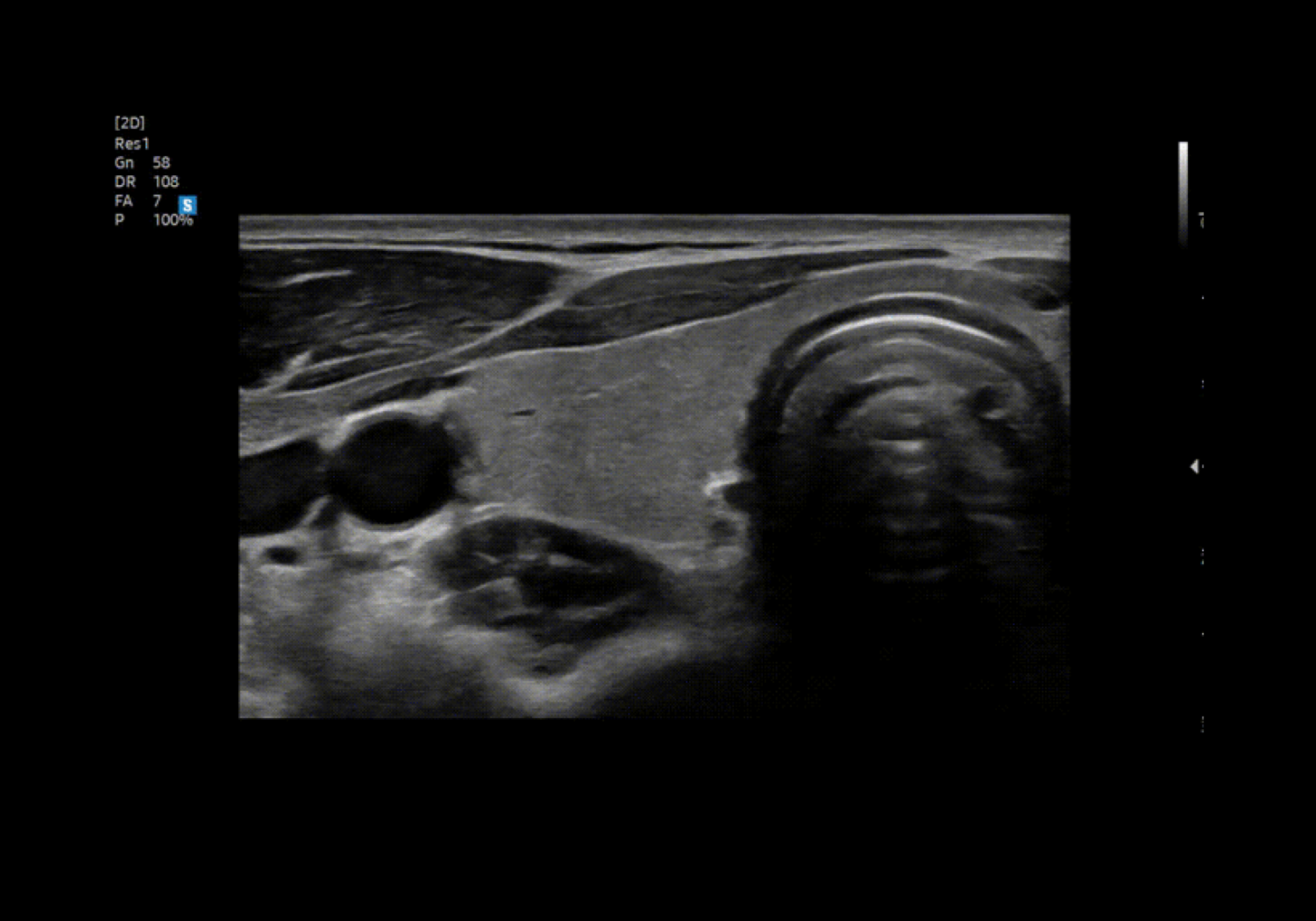
The assessment includes a consultation, examination of the neck, blood tests to assess thyroid function, ultrasound scanning and, in many cases, a fine-needle biopsy. At Charlottenlund Private Hospital, ultrasound scanning and ultrasound-guided fine-needle biopsy are performed by the specialist during the initial examination.
During a fine-needle biopsy, cells are collected using a thin needle while the specialist follows the needle on the ultrasound screen. The sample is then assessed by a pathologist. According to Danish recommendations, thyroid scintigraphy, which shows whether a nodule is active, is often included in the diagnostic assessment. Scintigraphy and other diagnostic imaging are not performed at the hospital, and patients are referred elsewhere if necessary. If you have already undergone these examinations, please bring the results with you.
How is a hemithyroidectomy performed?
The operation is performed under general anaesthesia. The surgeon makes an incision in a skin crease at the lower front of the neck, exposes the affected lobe and removes it.
During the procedure, particular attention is paid to the recurrent laryngeal nerve, which runs closely behind the thyroid gland, and to the parathyroid glands, which regulate calcium levels in the body. Nerve monitoring is used to help the surgeon identify and follow the recurrent laryngeal nerve during the procedure.
The removed tissue is always sent for microscopic examination. Depending on the extent of the procedure and your general health, the operation is performed either as an outpatient procedure or with one overnight stay at the hospital. Removal of the entire thyroid gland (total thyroidectomy) is not performed at Charlottenlund Private Hospital and takes place within the public hospital system.
How do you feel after surgery – tiredness, weight and thyroid function?
During the first few days, there may be soreness around the wound, mild swelling and some discomfort when swallowing. Many people feel tired during the first few weeks, which is a common effect of anaesthesia and surgery. Hoarseness may occur and is usually temporary.
In most cases, the remaining half of the thyroid gland takes over the full production of thyroid hormones. However, a pooled analysis of the scientific literature (Verloop et al., 2012) shows that around one in five patients develops an underactive thyroid after hemithyroidectomy. In most cases, this is mild and only detected in a blood test, while around 4% develop symptoms.
Thyroid function is therefore checked with a blood test by your GP a few weeks after surgery. Persistent tiredness, sensitivity to cold or weight gain may be signs of an underactive thyroid and should prompt another blood test. The condition is treated with thyroid hormone tablets.
Are there alternatives to surgery?
Yes. According to the Danish Endocrine Society, pressure symptoms caused by benign nodules can also be treated with radioactive iodine or so-called minimally invasive techniques, where a nodule or cyst is reduced in size using heat or alcohol delivered through a needle.
These methods are particularly suitable for nodules measuring 2–4 cm. If the nodule is larger, surgery is recommended. Many nodules do not require treatment and only need monitoring. Radioiodine treatment and minimally invasive techniques are carried out within the public hospital system.
The most appropriate treatment depends on the size of the nodule, thyroid function, the result of the tissue sample and the patient’s own preferences.
When should you see a doctor?
A new or growing swelling at the front of the neck should always be assessed by a doctor. The same applies to persistent hoarseness, difficulty swallowing or pressure in the neck. Your GP can arrange blood tests to assess thyroid function and refer you for further investigation.
If there is a well-founded suspicion that a nodule may be malignant – for example, a hard fixed nodule, rapid growth or hoarseness together with a nodule – the assessment takes place within a cancer pathway in the public hospital system.
A swelling in the neck may also be caused by a neck cyst or an enlarged salivary gland, and this can be clarified during the same examination.
Referral
The vast majority of patients at Charlottenlund Privathospital are referred through health insurance; providers typically require a referral from your GP and prior authorisation. No referral is needed if you are paying for treatment yourself, and prices are listed in the price list.
Frequently asked questions
What is a hemithyroidectomy?
An operation to remove one of the thyroid gland's two lobes. It is the most common operation for benign nodules and goitre causing pressure symptoms.
What does the thyroid gland do?
The thyroid gland is located at the front of the neck and produces the thyroid hormones T3 and T4, which regulate the body's metabolism. Their production is controlled by the hormone TSH from the pituitary gland.
Are thyroid nodules dangerous?
The vast majority are benign. According to the Danish Endocrine Society, the main purpose of assessment is to rule out the small number that are cancerous.
Can you live with half a thyroid gland?
Yes. In most people, the remaining half takes over hormone production. Around one in five develop an underactive thyroid, which is treated with thyroid hormone tablets.
Why are you tired after goitre surgery?
Feeling tired during the first few weeks is common after anaesthesia and surgery. If it persists, your thyroid function should be checked with a blood test by your GP.
Do you gain weight after thyroid removal?
Weight gain can be a sign of an underactive thyroid. If your blood test is normal, or your treatment is correctly adjusted, the operation itself will not affect your weight.
Does a fine-needle biopsy hurt?
It feels like a blood test needle prick and takes a few minutes. The sample is taken under ultrasound guidance.
Will the operation make me hoarse?
Hoarseness can occur because the vocal cord nerve runs close to the gland. It is usually temporary.
Do you need to stay overnight?
The operation is performed as day surgery or with one overnight stay, depending on the extent of the procedure and your general health.
Do I need a referral?
Health insurance providers typically require a referral from your GP and prior authorisation. No referral is needed if you are paying for treatment yourself.